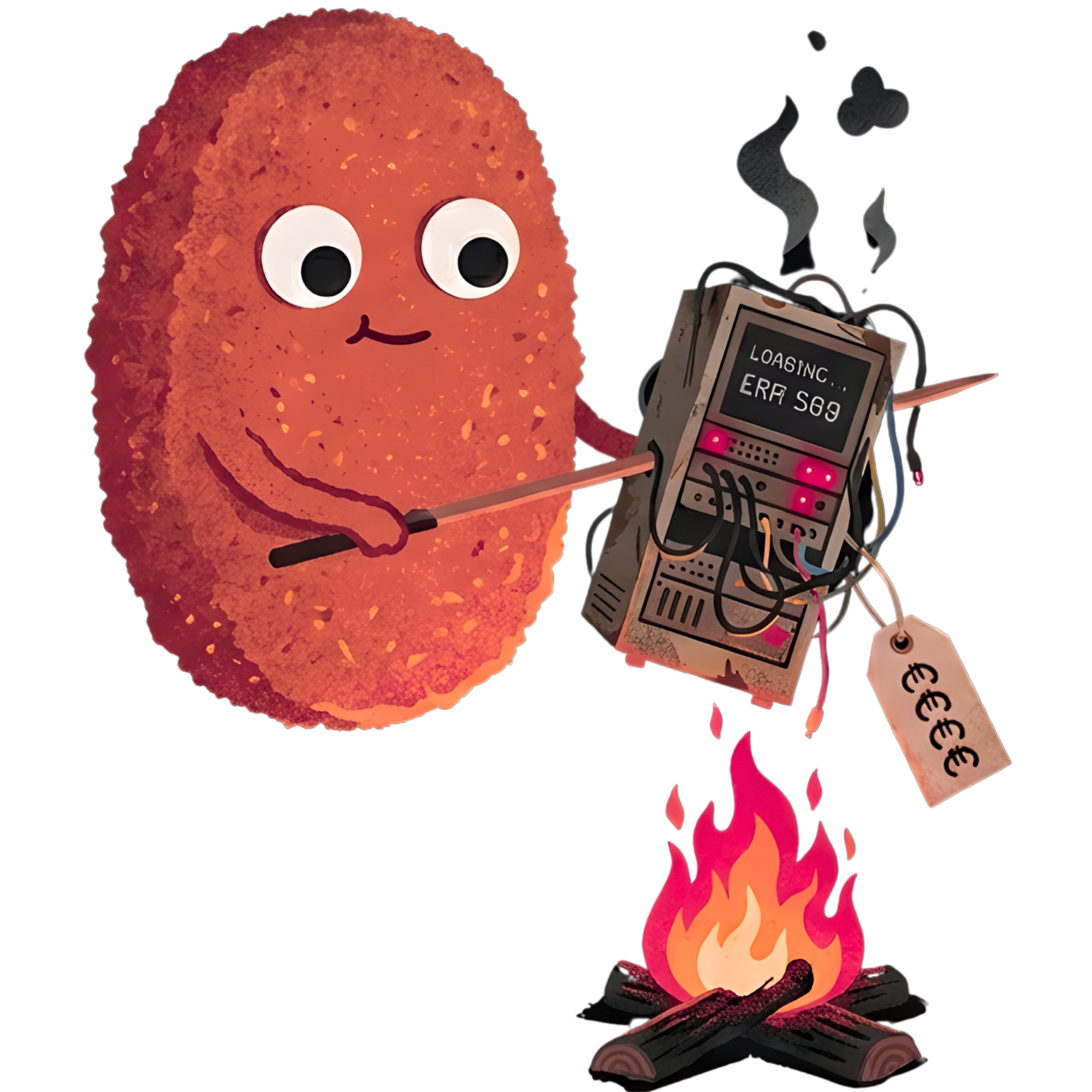
Artist's rendering. No legacy systems were harmed. Probably.
Kotletti.Finally, a healthcare system named after something you can actually digest.
It should be this simple
What a healthcare system owes you
- Your medical record is yours. On your device. Not in a database accessible to thousands.
- You choose who sees what. A psychiatrist visit doesn't show up in your employer's insurance dashboard.
- Change doctors, cities, countries — your records come with you. No forms. No fax machines. No waiting.
- A lab processes your sample without ever knowing your name. The math proves the results are yours.
- A prescription is a signed document you carry to any pharmacy. The pharmacy verifies it cryptographically. No call-backs.
- When a breach happens, it affects one device — not five million people.
The problem is architectural
A doctor takes an oath.
Then the software breaks it.
And they all get breached.
What if we didn't?
The architecture
Your data belongs in your pocket.
Not in a honeypot.
A doctor takes an oath to keep your secrets. Then the architecture makes it impossible to honor. Kotletti is built on an identity-first model — patient data exists only where the patient has explicitly shared it. No central database. No honeypot. The math enforces the oath.
Read more about the identity-first modelHow it works
The patient is the record
Identity-first
Every actor in the system — patient, doctor, lab, pharmacy, device — has a cryptographic identity. Data flows between identities through explicit sharing. Nothing goes to a central database. Nothing is accessible by default.
Blind lab work
The doctor assigns a random ID to your sample. The lab never learns whose sample it is. The results are signed by the lab, matched by the doctor, and given to you. A lab breach exposes blind IDs — not patient identities.
Prescriptions without middlemen
A prescription is a signed document. You carry it to any pharmacy. The pharmacy verifies the doctor's signature cryptographically. No central prescription database. No fax machines. The math verifies it.
Insurance sees only what it should
The patient shares billing codes — not clinical notes, not psychiatric history, not the full record. If a claim needs justification, the patient shares the specific relevant notes. Insurance never has access to everything.
Emergency access that works
A signed medical summary card. Emergency contacts with cryptographic authority. Time-boxed access for verified responders. Emergencies don't require a central database — they require graduated options under patient control.
Devices as peers
A heart monitor shares data with you and your cardiologist. Not with the manufacturer's cloud. Not with the hospital's general IT. When you disconnect, the device has no lingering connection to your data.
What disappears
When the architecture is right,
most of the machinery is unnecessary
The principles
What Kotletti will be
Built like infrastructure
Linux runs the world. SSH secures it. Nobody reboots them on Tuesdays. Kotletti is built to that standard — boring, reliable, and invisible when it works.
Everywhere and nowhere
The server is everywhere and nowhere at the same time. That's how peer-to-peer works. There is no central place to attack. The way the real world works, but digitally.
Usable or it evolves
If it's hard to use, it forks. It branches. It evolves into different apps until every nurse, doctor, and patient actually wants to open it. Usability isn't a feature — it's the survival mechanism.
A Finnish export product
Finland builds things that work in silence. Kotletti will be a vientituote — an export product. Built here, useful everywhere. Healthcare doesn't stop at borders. Neither should the software.
Taxpayer-friendly
The current systems cost hundreds of millions and still surprise their users. Kotletti is open source. The savings aren't theoretical — they're inevitable.
Voices from the field
What the people say
I klik seven taims for opening one patient. SEVEN TAIMS! My finger is now like maratton runner. Wery atletik finger. Rest of me, not so mats. De system is not helping me, it is training me. But in rong direktion.
De old system vas updating. Tree hours. I drink vone kahvi. Den anoder kahvi. Den I start knitting. I finish hole sokk before de system finish loading. Now I haff wery nice sokks but patients are still vaiting.
Dey said new system is koming. Dat vas 2015. Den 2017. Den "soon." My dotter vas born, vent to skool, and learned to kode faster dan dis deployment. She offered to help. Dey said no. Of kourse dey said no.
I press save. Nossing happen. I press again. Nossing. I press törd taim — now I haff tree same preskriptions. Patient gets enaf antibiotiks for hole village. Wery effisient. In rong direktion.
De training vas two viiks. TWO VIIKS! For writing notes! I vent to medikal skool six years and it vas easier to understand de human body dan dis user interfeis. At least de body makes some sense, you know.
Samvone asked me how mats de system kost. I told dem. Dey tought I vas talking about a brits. No no, I said, brits vould be tsiper. And de brits you kan aktually kross to de adder side.
These are fictional characters. Any resemblance to your actual Tuesday morning is purely coincidental.
Open source
Software you can inspect
is software you can trust
Readable
Healthcare software handles lives. The code should be open to every developer, auditor, clinician, and citizen who wants to look. Not because we're idealistic. Because it's irresponsible not to be.
Forkable
Don't like a decision we made? Fork it. Improve it. Run your own. No permission needed. No license fee. No phone call to a sales team that doesn't pick up.
Auditable
Every commit is public. Every decision has a trail. When someone asks "why does it work this way?" — the answer is never "we'll get back to you."
Why "Kotletti"
It's a cutlet.
A kotletti is straightforward. You know what's in it. You know what it costs. It doesn't need a brand strategy or a twelve-month onboarding program. It's just good, honest, ordinary food.
Healthcare software should be the same. Not a seven-course mystery menu. Not a molecular gastronomy experiment funded by taxpayers. A cutlet.
Also, we're Finnish. We like naming things after food. Don't overthink it.
Talkoot
This is a talkoot.
In Finland, when something needs building, the neighbours show up. No contracts. No procurement rounds. You bring what you know. Someone brings coffee. The work gets done.
That's how Kotletti is built. Not by a vendor. By people who use healthcare systems, build healthcare systems, or simply believe they should work better than they do.
Developers
Write code. Review code. Break things in staging so they don't break in production.
Clinicians
Tell us what's wrong. Not with the code — with the workflow. You know where it hurts.
Designers
Make seven clicks into one. Make the important thing visible. Make the screen feel calm.
Everyone else
Translate. Document. Test. Ask hard questions. File issues that start with "why does it—" We need those most.
Pull up a chair.
The talkoot has started.
Join the build. Ask a question. Or just tell us what's broken in the system you use today.